




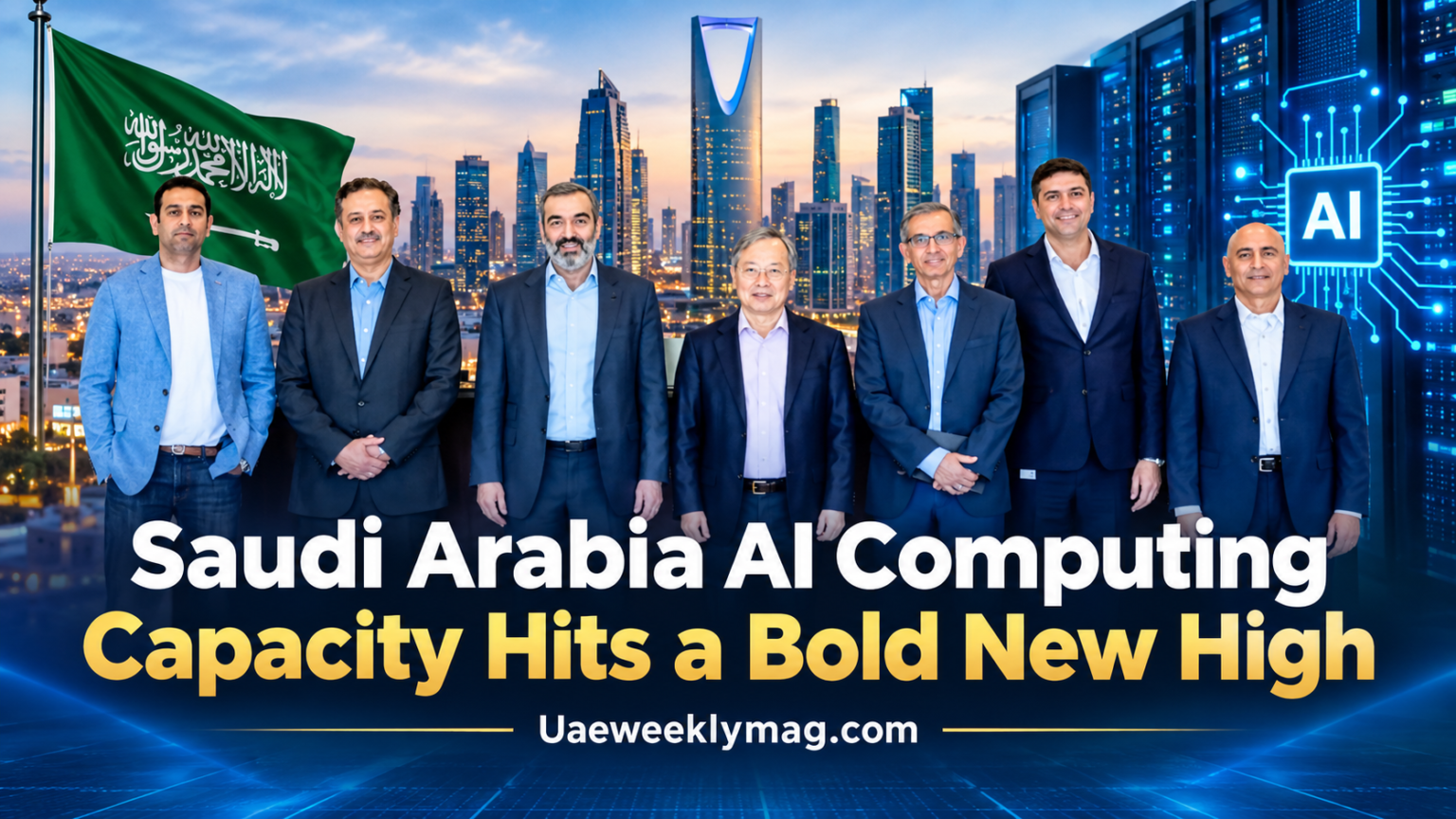
Saudi Arabia AI computing capacity is growing quickly as the Kingdom works to become a major global hub for artificial intelligence. Saudi Arabia is now partnering with private companies to build more than 14 gigawatts of computing power.
This massive project aims to attract leading AI companies from around the world. It also supports the large-scale use of advanced technology across many industries.
Saudi Arabia AI Computing Capacity Explained
This exciting update was shared at the Frontier Leaders Forum 2026 in Silicon Valley. The event was held under the theme “AI Forward: A Global Frontier.”
Minister of Communications and Information Technology, Abdullah Alswaha, explained that Saudi Arabia is building an integrated system. This system combines advanced computing power, strong financial investment, and direct access to global markets.
The goal of expanding Saudi Arabia AI computing capacity is to help AI companies grow more easily on an international scale. This includes reducing costs and improving how efficiently technology systems operate.
Alswaha also mentioned Saudi Arabia’s early investment in a company called Groq as an example of successful partnerships. He said the Kingdom hopes to build similar partnerships with other major technology companies in the future.
A Wide-Ranging AI Strategy
According to Alswaha, Saudi Arabia’s AI strategy covers many different types of technology. This includes generative AI, agentic AI, and physical AI systems.
These technologies have many real-world uses. Examples include healthcare tools, virtual assistants for government services, and self-operating systems used in logistics and transportation.
Much of this growth is connected to a Saudi initiative called HUMAIN. This platform focuses on developing advanced computing infrastructure to support AI companies working within the Kingdom.
Talks With Major AI Leaders
During his time in Silicon Valley, Alswaha met with several major technology leaders. One of these meetings included OpenAI CEO Sam Altman. They discussed expanding cooperation on advanced AI models and using HUMAIN’s computing systems to support larger AI projects.
Alswaha also met with Dell Technologies CEO Michael Dell. Their discussion focused on combining Dell’s AI technology solutions with HUMAIN’s computing capabilities. They also spoke about sharing knowledge and building local technology skills within Saudi Arabia.
Another meeting took place with Cognition AI CEO Scott Wu. This conversation focused on expanding software tools that can perform tasks automatically, using AI systems built on HUMAIN’s infrastructure.
Alswaha also spoke with Solidigm’s Senior Vice President, Kyle Fukuda. Their discussion focused on improving data storage technology to support faster and more efficient AI data centers.
Attracting Global Investment
Investment was another major focus of these discussions. Saudi Arabia is working hard to attract global financial support for its growing AI and technology infrastructure.
Alswaha met with General Catalyst CEO Hemant Taneja to discuss increasing AI-related investments in Saudi Arabia. They also explored how companies supported by General Catalyst could expand their AI solutions using HUMAIN’s technology.
He also spoke with Social Capital’s founder, Chamath Palihapitiya, about investing in Saudi Arabia’s technology infrastructure and computing systems.
These meetings build on earlier discussions with major investment firms, including Andreessen Horowitz and Sequoia Capital. These talks focused on increasing investment in Saudi AI and technology companies.
If you’d like to explore more stories about Saudi technology growth, check out our Saudi Arabia tech news section and our AI industry updates for more helpful reading.
You can also learn more from Saudi Arabia’s official HUMAIN platform for updates on the Kingdom’s AI infrastructure projects.
Building Advanced AI Models and Hardware
Saudi Arabia is also focused on developing advanced AI models and supporting hardware systems. Alswaha met with Arcee AI’s founder, Mark McQuade, to discuss expanding advanced AI models using Saudi Arabia’s national infrastructure.
He also spoke with Engramme’s co-founder, Gabriel Kreiman, about improving how AI systems learn and remember information over time.
On the hardware side, discussions with Supermicro’s founder, Charles Liang, focused on building efficient, high-performance computer systems that use advanced cooling technology.
Alswaha also met with technology leaders from Upscale AI and Velaura AI. These discussions focused on improving computer networking systems and building more energy-efficient data centers.
Additionally, talks with TenX Semi’s CEO, Dr. Suk Hwan Lim, explored how AI tools could help design and test computer chips. This supports Saudi Arabia’s long-term goal of building its own semiconductor industry.
A Bigger Vision for Technology
All of these efforts are part of a much larger plan. Saudi Arabia is working to build a complete technology ecosystem. This includes AI models, computing infrastructure, data centers, semiconductors, robotics, and investment opportunities.
By connecting global technology companies and investors with local infrastructure, Saudi Arabia hopes to speed up the use of AI across many important industries.
This strategy also aims to strengthen the Kingdom’s position as an international center for computing power, innovation, and applied artificial intelligence.
Final Thoughts on This Growing Tech Hub
The rapid growth of Saudi Arabia AI computing capacity shows just how serious the Kingdom is about becoming a global leader in artificial intelligence. Through strong partnerships, major investments, and advanced infrastructure, Saudi Arabia is positioning itself at the center of the world’s growing AI industry.
As these projects continue to develop, Saudi Arabia’s role in shaping the future of technology is expected to grow even further in the coming years.
Read More : Uae Weekly Mag
Reference By : Economy Middleeast